“In the summertime, when the weather is high, you can stretch right up and touch the sky.” (Mungo Jerry)
Summer’s here with its blue skies, happy holidaymakers from around the country and the world, and, as always, an upsurge in demand for houses. If you’re going to capitalise on this seasonal upswing, start planning your sales strategy now with our simple, practical Seller’s Checklist below.
Follow these 10 steps for a successful sale:
1. Ask yourself “What’s my goal and how will I get there?”
The first step is to outline your strategy, starting with your end goal. Of course, all sellers want to get the best price and to get paid out as quickly as possible, but brainstorm the specifics. What price do you actually want to achieve? Define your perfect buyers (a critical and much-overlooked step) and think about how you’ll find them. Which estate agent should you employ? And so on…
It pays to bring us in from the start. Not only can we help you find the right agent for the job, but we’ll also tell you what prices are being achieved in your area and share our thoughts on how to avoid the over-pricing trap – a common mistake which can taint a property for months, or even years.
We’ll also outline the whole sales and transfer process for you from a legal perspective, highlighting both the potential pitfalls to watch out for, and the many ways in which you can help make the whole process as smooth, quick and hassle-free as possible.
2. Give notice to your bondholder
If you have a home loan, remember that some banks will charge an early settlement penalty unless you give them 90 days’ written notice.
3. Prepare a cashflow projection
Get your finances ready to cover all your selling costs, including:
Compliance certificates and any repair work needed to get them issued.
Bond cancellation fees (if you have a home loan).
Final municipal accounts (rates, refuse, sewerage, and water) and, if your property is in a sectional title scheme or Homeowners Association complex, outstanding levies.
CGT: Plan for possible Capital Gains Tax on your profit (subject of course to exemption thresholds).
Estate agent’s commission is normally paid out by the conveyancer on transfer – but don’t lose sight of it when you’re dreaming about how to spend the proceeds!
4. Spruce up your property
Pretend you’re a house hunter seeing your property for the first time:
What’s its “kerb appeal”? How about its “front door appeal”? First impressions can make or break a sale, so ask yourself “what will potential buyers see when they first drive up to my property, park, and walk through the garden into my house?” Imagine being greeted by a neat, tidy, colourful garden with a sparkling pool, bright and airy rooms with homely wafts of fresh air and brewing coffee – get this bit right and you could seal the deal in the first few minutes of a viewing.
Declutter and tidy up, both inside and out, particularly on viewing and show days – the hassle is well worth it.
To give your property that all-important feeling of being well maintained, find and fix small issues like leaky taps, peeling paint, dark musty corners, scruffy gardens, murky swimming pools and the like. Deep clean if there’s any risk of doggy smells or stained carpeting spoiling that positive first impression.
And last but not least, we come to a deal breaker of note. Many a sale has been lost purely because of old, unwelcoming bathrooms or kitchens. Spruce them up now: repaint, retile or renovate completely, if necessary.
5. Start getting your paperwork together
To speed up the transfer process when you do sell, and in case potential buyers ask to see them before offering, make a start now on putting these basics together:
Your original title deed (or a copy from your bank if the original is held as security for a bond). If the original has been lost, we’ll be able to get an early start on obtaining a replacement for you.
Your ID (and your spouse’s, if you own the property jointly or are married in community of property).
Approved building plans and any compliance certificates you already have.
A recent municipal rates account showing you’re up to date.
6. Make sure your property is compliant
Find out what compliance certificates you will need early so you have time to fix any issues:
Electrical compliance certificate.
Plumbing/water installation compliance certificate (required in Cape Town – check whether your local authority has any similar provision).
Gas compliance certificate if you have a gas installation.
Electric fence certificate (if applicable).
Beetle clearance certificate where needed.
7. Complete the disclosure form
You’ll need to sign a mandatory disclosure form in which you must list all defects or issues you know about, such as damp, leaks, structural issues, boundary disputes, unapproved alterations and the like.
8. Don’t sign blind
Most importantly, when you do get an acceptable offer, don’t sign anything until we’ve checked it all out for you. The terms and conditions in the sale agreement (often titled “offer to purchase”) become binding as soon as you sign. There’s no going back and many a seller has regretted “signing blind”. Even “standard” clauses may come back to bite you because every sale’s different, and every seller has their own areas of risk.
9. Nominate the conveyancer
It’s your right as seller to choose the conveyancer, so don’t let anyone convince you otherwise.
10. Communication is key!
Remain in constant touch with your agent, with us, and with the buyer. Quick responses to requests for documents or signatures can save days or even weeks in the transfer timeline.
In closing…
Selling a property doesn’t have to be stressful. Work through this checklist step by step and keep us constantly in the loop to avoid delays, disputes, and unwelcome surprises.
Disclaimer: The information provided herein should not be used or relied on as professional advice. No liability can be accepted for any errors or omissions nor for any loss or damage arising from reliance upon any information herein. Always contact us for specific and detailed advice.
“Don’t wait to buy real estate. Buy real estate and wait.” (Will Rogers)
Spring is in the air and, as the annual uptick in property sales kicks in, let’s address two questions commonly asked by both sellers and buyers who are unsure about exactly what happens after they sign their sale agreement:
How does the transfer process work?
How long does it take before the seller gets paid and the buyer becomes the new registered owner?
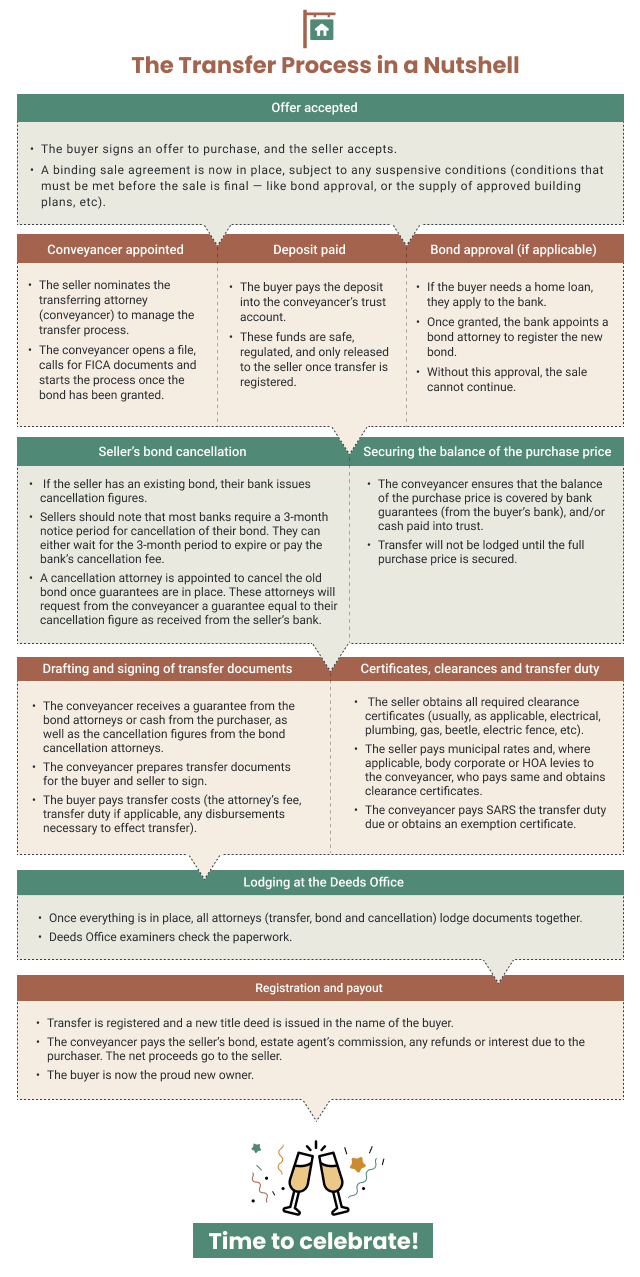
Let’s begin with this simplified “in a nutshell” flowchart of the transfer process:
How long does it all take?
How long is a piece of string? If everything goes swimmingly and the bureaucratic stars truly align in your favour, the total timeframe from signing the sale agreement to popping the champagne could be as little as eight weeks. On average, however, it’s safer to work on no less than ten to 12 weeks, and possibly a lot more.
What could delay things? This is a complicated process involving a disparate array of role-players and a host of opportunities for unforeseen delay. Some of the more common sources of delay (and frustration!) centre on bond approval, bank processes, SARS and municipal delays, clearance certificates and repairs, lost title deeds, intervening public holidays, and Deeds Office backlogs. But the list really is endless.
Bottom line: you need professionals in your corner to protect your interests and to move the process along as quickly as possible. We’re here to help!
Disclaimer: The information provided herein should not be used or relied on as professional advice. No liability can be accepted for any errors or omissions nor for any loss or damage arising from reliance upon any information herein. Always contact us for specific and detailed advice.
“If you suspect deceit, hit delete!” (Online cybersecurity slogan)
October is Cybersecurity Awareness Month, a good time to note that as cybercrime continues to grow, more and more businesses and individuals are falling victim to the dreaded “BEC” or “Business Email Compromise” fraud.
The million-dollar question: Who takes the hit?
Typically in a BEC fraud, email or other electronic communications between a creditor and debtor (often a seller and buyer, or service provider and client) are hacked by criminals, who con the debtor into paying what they owe into the fraudster’s bank account. By the time the parties realise they’ve been had, the criminals are long gone, and all that remains is the million-dollar (sometimes quite literally!) question: “Which one of us takes the hit?”
Until now we have been faced with conflicting High Court decisions on this point, but now the SCA (Supreme Court of Appeal) has settled it: The risk is the debtor’s.
A car dealership must pay twice over
It was a classic case of BEC: A dealership bought two Hyundai Nissan NP200 vehicles from another dealership for R145,000 each. The seller issued invoices showing its banking details. The buyer paid by EFT and sent proof of payment to the seller, which happily (without checking that the funds had actually landed in its account) delivered the vehicles to the buyer.
As always with these cases, one can imagine the sinking feeling that greeted the parties’ realisation that the seller’s emails and the attached invoices had been intercepted, and the banking details subtly altered. As a result, the buyer had paid the full R290,000 to the criminals’ bank account.
Long story short, a real seesaw of a legal battle ensued. The buyer said, “I’ve already paid you”. The seller retorted, “No you haven’t, you paid the criminals,” and sued the buyer for the R290k. The seller won in the Regional Court, lost on appeal to the High Court, but then turned the tables again and celebrated victory in a further appeal to the SCA.
Verify, verify, verify
The SCA’s findings amount to this:
The onus is always on you as buyer to prove, on a balance of probabilities (i.e. more likely than not), that you have paid the seller.
When you pay by EFT, you must show that the seller actually got the money. In other words, that you paid into the correct bank account.
Creditors (recipients) have no legal duty to protect debtors (payers) from the possibility of their accounts being hacked where the debtor could have taken steps to protect itself but failed to do so.
The obligation therefore is on you as debtor to ensure that the bank account details in the invoice are in fact correct and verified because “it is the debtor’s duty to seek out his creditor”. Fail to follow basic verification steps, and your payment to the wrong account does not remove your liability to pay the debt — you still have to pay your creditor.
Bottom line, the buyer in this case should have verified the banking details given in the emailed invoices before paying. It didn’t, so it couldn’t prove that it had paid into an account authorised by the seller.
It must pay the seller the R290k, with interest and doubtless substantial legal costs.
Don’t make the same mistake
These scams grow more sophisticated by the day, fuelled now by AI-perfected deep fakes, cloned websites and social engineering. Treat all emails, all electronic messages, and all electronic invoices with great suspicion — even if they appear to come from businesses you have known and trusted for decades. Verify bank account details (preferably by speaking to the creditor directly on a number you know to be correct) before paying a cent.
Property sales are particularly vulnerable
Be especially vigilant when buying or selling property because these high-value sales are a particular focus for cybercriminals worldwide. There are rich pickings in the offing, and the opportunities for baddies to intercept and falsify emails is multiplied by the range of trusted role players involved — typically several sets of attorneys, estate agents, and banks as well as the buyers and sellers themselves.
A final note on online security
Let’s end off with a note to everyone: Keep reminding your whole team (not just your accounts department) that securing your computer and email systems against bad-actor compromise is no longer a nice-to-have, it’s essential. This whole unhappy saga could all have been avoided if everyone involved had followed basic security protocols. Prevention is always better than cure.
Give us a call if you need any help.
Disclaimer: The information provided herein should not be used or relied on as professional advice. No liability can be accepted for any errors or omissions nor for any loss or damage arising from reliance upon any information herein. Always contact us for specific and detailed advice.
“You aren’t buying a house, you’re buying a lifestyle.” (Anon)
As more and more residential properties are subdivided and developed, an increasing number of homes are effectively cut off from direct access to the nearest public street or road.
That’s where the “panhandle” comes into play, a narrow strip of land (looking on diagrams very much like the handle of a pan, hence the name) which gives the needed street access to the “landlocked” property. The panhandle can be owned by the property using it as an access road, or it can be a right of way in favour of the property over neighbouring land.
A recent High Court run-in between two neighbours over a panhandle right of way highlights the mistakes made by the various parties involved, and so provides a neat “must do” checklist for everyone in such a situation – buyers, sellers and neighbours alike.
“Wait, what right of way?”
You can imagine the reaction of a property buyer when he was told, only after taking transfer, that his nice little plot was lumped with a registered servitude. Not only did he have the neighbour freely crossing his land at will via a four-metre wide panhandle road, but he also found himself blocked from part of his own land by the neighbour’s gate.
Luckily for the buyer, the servitude turned out to be a temporary one. The wording stated clearly that it was to provide a right of way only until alternate access became available to the neighbour. And a consolidation of neighbouring properties (involving the creation of eight mini subdivisions for a property development) had indeed opened up such an alternative access route.
The buyer accordingly asked the High Court to declare the servitude lapsed, and to order that all “barriers and obstructions” to the panhandle be removed. His neighbour fought back, arguing amongst other things that he had paid R35,000 to the original owner of the buyer’s property as part of a verbal agreement to increase the panhandle’s width from four to six metres.
The neighbour’s problem here is that a servitude has to be in writing, so his verbal agreement with the original owner for a six-metre servitude was unenforceable – certainly against this buyer who had never agreed to it. For a servitude to bind a subsequent buyer of the property, it needs to be registered against the title deed.
The Court accordingly held that the registered four-metre servitude had lapsed and that the supposed six-metre servitude agreement was unenforceable against the buyer. End result, the neighbour loses his right of way and must remove all “obstructions” (the gate, presumably) on it.
Buyers, sellers and neighbours: Mistakes to avoid
Buyers: Don’t only wake up after transfer to the fact that your new property is subject to a right of way or other right of access – it could do serious harm both to your property value and to your enjoyment of it. Check the title deed before making an offer. As we shall see below, relying on the seller to disclose a servitude during the sales process can be wishful thinking…
Sellers: The seller in this case didn’t disclose the servitude, as he was obliged to, in the mandatory disclosure form – the form that every property seller must sign and provide to the buyer. In it a seller must disclose not only any known property defects, but also things like encumbrances, zoning and title deed restrictions, unapproved alterations or additions, and so on. Presumably the seller’s omission in this case was just an oversight, but he could still easily have been sued by the buyer. It’s vital that you always complete that form fully and accurately.
Neighbours: As the neighbour in this case found out to his cost, if you are reliant on a right of way, make sure it’s granted in a written and registered servitude. He might perhaps have been able to enforce his verbal agreement against the original owner, but it was worthless against a subsequent buyer who knew nothing of the agreement.
Disclaimer: The information provided herein should not be used or relied on as professional advice. No liability can be accepted for any errors or omissions nor for any loss or damage arising from reliance upon any information herein. Always contact us for specific and detailed advice.
“Dance like no one is watching, but text, post, and email like it will be read in court one day.” (Anon)
When can the target of rude comments and insults on a community Facebook group sue?
The High Court recently grappled with a community debate over free-roaming jackals that turned sour.
The golf estate and the Facebook group
The scene here is one of Sandton’s large and secure golf estates, whose closed Facebook group, aimed at fostering community spirit, reaches some 1,800 residents.
Jackals roaming freely on the estate were at the heart of this dispute, with residents split into two opposing camps.
In one camp, those believing that all wildlife in the estate should be left alone – including the jackals.
In the other camp, those arguing that, as well as being predators dangerous to other animals (including domestic pets), jackals are carriers of rabies. Presumably this group advocates some form of control measure, no doubt an emotive topic.
Cat pics and Karen insults
The online debate between the two sides began civilly enough, but that changed with a series of posts by a prominent supporter of the “hands-off-the-jackals” lobby. In criticising the other camp, she targeted one of them by name. Stung, the recipient of what she perceived as insulting and defamatory attacks, demanded that her opponent remove the posts and apologise to her.
Central to the outcome of this case are the posts themselves. They included an image of a cat in a spiked vest (with the comment “maybe this will help the cats”), suggestions that the target of the posts shouldn’t be living in Africa, that she had published false information on the group, and that she was “stupid” and a “stupid keyboard muppet”. She read further posts as referring to her as a “B” (she took this to mean “bitch”) and as caricaturing her as a dog (with a bob haircut like hers) and as a “Karen”.
Off to court with a two-pronged attack
As a professional (actually a business rescue practitioner), the complainant wasn’t prepared to take any of that lying down. Offended by the poster’s refusal to retract, she sued her in the Magistrate’s Court for damages of R250,000, asking also for orders to remove the posts and apologise publicly for them.
She lost, appealed to the High Court and lost again. Why?
It’s important to note firstly that she had launched a two-pronged legal attack, enabling her to prove a valid claim for either or both of actionable insult (where offending statements injure your dignity or self-worth) and defamation (where they damage your reputation). To win, she needed to show either that the statements referred to her and were defamatory of her, or that they were wrongful and hurt her dignity.
Her failure to convince the Court that she had a case was partly because she hadn’t been able to prove all the facts needed to establish a case. But it was also rooted in two principles which anyone engaging in public debate (online or otherwise), and anyone thinking that an insult is perfectly fine if it’s structured as a “joke” or “jest”, needs to take note of.
Let’s have a look at each principle.
Public debate is not for sissies
The Court: “The law expects those who take part in public discourse to do so with a degree of pliancy and robustness. A subjectively hurtful remark is not wrongful unless a reasonable person in the plaintiff’s position would take exception to it.”
More particularly, this being a closed group of neighbours in a security complex: “Those who engage in online debate about matters of mutual interest between neighbours ought reasonably to foresee that the criticism they sustain may be tart and, at times, discourteous.”
In this case, while some of the posts were definitely rude and hurtful, no reasonable person would have thought that they had tarnished their target’s reputation. Rather, readers would have thought less of the poster “because she was unable to keep to civil terms of debate.”
Everything said in jest?
Some, but certainly not all, “jokes” are safely posted. The poster of this “cat in spikes” picture said it was just a light-hearted joke, and the Court agreed. A joke can certainly be defamatory if it’s a deliberate attack on the target’s reputation – but in this context, it was just “a satire of the entire debate between the parties.” It wasn’t, said the Court, “of the defamatory kind”.
Turning to what appears to have been another attempt at a joke in the form of the dog caricature and “Karen” reference, what saved the poster here was the lack of proof that this was actually aimed at the claimant. Had it been, calling her a “Karen” (“a privileged, entitled woman with a thin skin and a quick temper”) would have opened her up to ridicule and “would probably have been defamatory”.
There’s a fine line or two there. Call us before posting if you aren’t sure that you’re on solid ground!
Disclaimer: The information provided herein should not be used or relied on as professional advice. No liability can be accepted for any errors or omissions nor for any loss or damage arising from reliance upon any information herein. Always contact us for specific and detailed advice.
“Time shall unfold what plighted cunning hides.” (William Shakespeare, in King Lear)
A recent High Court judgment confirms, yet again, that if a property seller knows about a hidden defect and keeps it quiet, no exemption clause will save them.
A loud roar, rolling flames, and a dream home turns to ashes
A family thought they were moving into a solid, well-built family home (a dual-level freestanding residential townhouse). They had no idea a hidden hazard was buried in the walls above their fireplace.
They found out on a cold and rainy Free State night when they lit a winter fire, as they had done many times before. This time they were in for a shock. All went well until, watching television some hours later, they heard a loud crack like a gunshot…
When the man of the house looked up the staircase, he noticed a glow. He found that the top floor spare room was on fire, with the curtains and bed already alight. A loud roar and flames rolling under the cornice caused him to retreat. He shouted to his wife to gather their pets and call for help, and they escaped outside to await the arrival of the fire department.
The family got out unscathed. But the extensive damage caused by the fire and the collapse of the roof rendered the unit uninhabitable.
The hidden fire hazard
Unbeknownst to the buyers, during construction, a roof truss beam had been built through the chimney brickwork. Building regulations read with the applicable code of practice forbid this, because any timber near a flue is a fire waiting to happen: “Combustible material such as a timber floor joist, trimmer or roof truss shall not be built within 200mm of the inside of a chimney; and … No flue pipe shall be designed and installed in such a manner that it will cause a fire hazard to any adjacent material.”
Faced with a devastated home and huge repair costs, the buyers took the developers, who had both built and sold the house, to the High Court, where a forensic fire expert explained that the origin of the fire could be traced to the beam in question. Over time, repeated heat exposure had dried out and charred the timber. On the fateful evening, it finally caught alight, and the fire spread to the polystyrene ceiling cornices, which melted and dropped flaming debris onto bedding in the upstairs room directly above the fireplace.
Voetstoots? Forget it!
The developers argued they weren’t liable because the sale agreement contained a standard exemption (“voetstoots”) clause and could not therefore be held to account for a hidden defect such as this one.
In short, the developer’s position was: “You bought the house as it stood, defects and all, whether you could see them or not.” They also pointed out that the buyers had signed an acknowledgement that they’d inspected the house.
But the Court was clear: “It is the duty of the seller to deliver the thing sold to the buyer without any defects.” Voetstoots clauses don’t give a seller free rein to hide behind the contract if there’s fraud or dishonesty:
The defect was “latent”, in that it was hidden inside the chimney and could not have been discovered by a normal inspection.
The developer, as the builder, must have known of the latent defect, and whilst “fraud will not lightly be inferred, the fact that the chimney was not represented on the approved building plans occasions the reasonable inference that it fraudulently concealed the defect.”
Bottom line? By failing to disclose a defect that was dangerous and unlawful, the developer crossed the line from simple non-disclosure to fraudulent concealment.
Here’s how to avoid disaster and dispute
Sellers: Check carefully for any possible defects and make honest disclosure part of your sale process, particularly when completing the “mandatory disclosure form” that must be attached to the sale agreement. And don’t rely blindly on a standard exemption clause – it’s no guarantee of protection if a hidden defect comes back to haunt you.
Buyers: Always ask questions. Look at approved building plans, think of commissioning an independent home inspection, and don’t be shy to raise any concerns. If you suspect fraud after buying, don’t wait – get legal advice fast.
The bottom line
Hidden defects don’t stay hidden forever, no matter how cleverly concealed. Sooner or later, as Shakespeare put it, “time shall unfold what plighted cunning hides.”
If you find yourself facing the fallout of a seller’s dishonesty, we’ll help you protect your rights and recover what you’ve lost.
Disclaimer: The information provided herein should not be used or relied on as professional advice. No liability can be accepted for any errors or omissions nor for any loss or damage arising from reliance upon any information herein. Always contact us for specific and detailed advice.
We use cookies on our website to give you the most relevant experience by remembering your preferences and repeat visits. By clicking “Accept All”, you consent to the use of ALL the cookies. However, you may visit "Cookie Settings" to provide a controlled consent.
This website uses cookies to improve your experience while you navigate through the website. Out of these, the cookies that are categorized as necessary are stored on your browser as they are essential for the working of basic functionalities of the website. We also use third-party cookies that help us analyze and understand how you use this website. These cookies will be stored in your browser only with your consent. You also have the option to opt-out of these cookies. But opting out of some of these cookies may affect your browsing experience.
Necessary cookies are absolutely essential for the website to function properly. This category only includes cookies that ensures basic functionalities and security features of the website. These cookies do not store any personal information.
Any cookies that may not be particularly necessary for the website to function and is used specifically to collect user personal data via analytics, ads, other embedded contents are termed as non-necessary cookies. It is mandatory to procure user consent prior to running these cookies on your website.