“Wouldn’t it be nice to get on with me neighbours?” (from “Lazy Sunday” by Small Faces)
Maintaining friendly relations with the neighbours, or at least an “I’ll ignore you if you ignore me” sort of neutrality, has probably been a primary aim of homeowners since the dawn of history. No doubt even our cave dwelling ancestors were as keen to get on with the Joneses next door as they were to keep up with them. But as we all know, it’s not always easy.
A recent High Court fight over parking rights is unfortunately pretty much par for the course when it comes to neighbourly relations deteriorating into open conflict, both inside and out of the courtroom.
“You can’t park here!” “Yes, we can!”
The setting for this fight: Higgovale, a small and affluent suburb on the slopes of Table Mountain in Cape Town. In one corner: a couple with the right to access their garage using a servitude road. In the other corner: the neighbours, alleged to have impeded the couple’s garage access by parking in the road.
At the heart of the dispute: the road servitude. Servitudes involve a balancing act between the right of the “dominant owner” to exercise the servitude and the right of the “servient owner” to have the servitude exercised in such a way as to impose the “lightest burden” on their property. The tensions inherent in such a relationship can easily escalate into conflict – exactly what happened here.
The garage-owning couple’s initial stance was to ask the Court for a blanket interdict against all parking by the neighbours in the road, but they later softened that to ask only for an order against their garage access being obstructed.
The Court had no hesitation in ordering that the neighbours “are interdicted and restrained from parking vehicles on the servitude area at … Higgovale, in such a manner as to unreasonably obstruct the applicants from entering and exiting their property and exercising their right of way.”
In doing so, the Court took the parties to task for failing to settle their dispute out of court, and urged them “to engage with each other in a manner that promotes the spirit of ubuntu, and the constitutional vision of a caring society based on good neighbourliness and shared concern” (emphasis supplied), and to consider demarcating parking bays in the road as a short-term solution.
The parties now have to pay their own costs (except for the costs of one interim application), and they’re effectively back to square one: having to engage with each other to try to find a fair solution.
What’s a “reasonable neighbour”?
Per the Court (emphasis supplied): “While the common law requires that neighbours act reasonably, the Constitution shows what a reasonable neighbour looks like. She is not only concerned with advancing her own private interests but cares also for the needs of her neighbours. She seeks mutually beneficial solutions. The mindset of the reasonable neighbour is one of collaboration, not competition. She sees herself not as an isolated individual, but a partner in an interdependent community of persons, all of whom are to be respected and valued.”
First prize: Settle!
Courts want us to settle these sorts of disputes in that collaborative spirit, without recourse to law. But if a friendly discussion over a cup of coffee doesn’t resolve the situation, more robust action might be unavoidable – we’re here to help if you need us.
Disclaimer: The information provided herein should not be used or relied on as professional advice. No liability can be accepted for any errors or omissions nor for any loss or damage arising from reliance upon any information herein. Always contact us for specific and detailed advice.
“With a verbal agreement you have nothing but air.” (Author and entrepreneur Robert Ringer)
2026 opens with positive signals for our property market after last year’s encouraging GDP forecasts, a credit-rating upgrade, and a series of interest rate cuts boosting access to bond finance.
All the signs point to a promising year for buyers, sellers, and homeowners. But a recent Supreme Court of Appeal (SCA) judgment is a sharp reminder that getting the legalities wrong, and in particular trying to rely on verbal promises, could mean a very rocky start to your new year. It’s also a reminder that while co-ownership can be a practical way to access and share property, it must be properly structured. When relationships sour, the fallout – as this case aptly shows – can be severe.
One husband discovered all that the hard way, so let’s learn from his mistakes.
“You can’t evict me, I own half the house!”
The central feature of this unhappy tale is unfortunately an all too common one – a personal relationship gone horribly wrong.
A couple married in 2009 and jointly bought a house in 2015. When the husband hit financial trouble in 2017, and creditors threatened to attach his half share, the couple agreed that the wife would buy him out for R1.2 million. A written Deed of Sale was signed, the transfer went through, and she became the registered sole owner. Unsurprisingly, given the purpose of the sale and transfer, she never actually paid him the R1.2 million purchase price.
When the marriage hit the rocks in 2019, she moved out and he stayed on. They divorced but he refused to vacate, arguing that the Deed of Transfer did not reflect their “true intention”. This, he claimed, was for him to remain a co-owner “until it was less risky”, after which she would give him back his half share.
The dispute landed in the SCA, where the ex-wife insisted that the intention was always that the property would be hers alone.
The SCA held that ownership is a question of law, not a factual dispute to be resolved by choosing between different versions of a story. The Court found that the ex-wife remained the sole owner, and its reasons for doing so provide a clear checklist of principles that every buyer, seller, and property owner should keep in mind.
What the ex-husband got wrong, and how to get it right
Let’s discuss the legal principles that sank the ex-husband’s case:
Don’t rely on a verbal agreement: Although our law makes most verbal contracts binding, there are exceptions. One is that any agreement to sell, exchange, donate, or transfer land (or a right to claim transfer) must be in writing and signed to be valid. That includes any “side deals” intended to vary the terms of the sale agreement. So, even if the Court had accepted the ex-husband’s version, a verbal promise to “give back” a half share would have been void and unenforceable.
Make sure your sale agreement is crystal clear: The Court also found the alleged verbal agreement to be “fatally vague” – a poignant reminder to always record agreements with enough detail to avoid them being struck down as “void for vagueness”.
A non-variation clause is essential: Contracts should state that they may not be changed unless the variation is in writing and signed. This is a great way to protect against uncertainty and dispute. The Deed of Sale here contained such a clause, which made the husband’s purported verbal amendment ineffective. There’s a lesson for us all here: never accept verbal assurances or promises from the other party, always insist on them being properly incorporated into the sale agreement in writing.
The value of a “whole agreement” clause: This clause confirms that the written contract reflects the entire agreement. With it in place, no outside evidence can contradict or add to the document – yet another reason the ex-husband found no joy at the SCA. Make sure that your written sale agreement is comprehensive, with nothing important omitted!
On transfer, “intention to pass ownership” is binding and motivation is irrelevant: The couple in this case transferred ownership intentionally and deliberately, and their personal motives for doing so were irrelevant. Equally irrelevant was the fact that the wife never actually paid the husband the purchase price – all that counted was the intentional transfer of ownership.
Complying with all legal formalities is important whether you are a buyer, a seller or an owner. As always, sign nothing without our advice!
Disclaimer: The information provided herein should not be used or relied on as professional advice. No liability can be accepted for any errors or omissions nor for any loss or damage arising from reliance upon any information herein. Always contact us for specific and detailed advice.
“Landlords grow rich in their sleep.” (John Stuart Mill, economist)
If you are thinking of buying (or already own) a house or apartment in a residential complex with the idea of renting it out as an Airbnb (whether permanently or on an “I can make a fortune this Christmas” basis), tread carefully.
A recent High Court decision has signalled confirmation that your body corporate or homeowners’ association (HOA) can, within limits, regulate your right to do so.
Residents vs. Renters
The setting for this dispute is a large residential scheme in the Silver Lakes area of Pretoria, envisioned by its developers as “a family orientated lifestyle estate where families enjoy the various amenities which include the outdoors, beach and water activities in a safe and secure environment.”
However, many of the owners don’t reside in the complex permanently but rather let their units out on a short-term letting (“STL”) basis as holiday accommodation, usually for one to three days at a time.
That, says the Homeowners’ Association (HOA), has become a major problem for residents, because holidaymakers renting the units don’t always adhere to the rules and family ethos which it tries to maintain and preserve. The short-term tenants are, it says, there only to party and have a good time, which predictably has led to endless complaints from residents relating to noise, overcrowding, traffic congestion, raucous behaviour, security risks and so on.
As its original conduct rules proved inadequate in addressing these concerns, the HOA adopted new, stricter short-term letting rules. Among other restrictions, owners were now prohibited from letting out their units for periods shorter than three months without the HOA’s prior consent. Contraventions of this rule attracted a penalty of 90% of the monthly levy.
These rules were originally approved by the Community Schemes Ombud Service (CSOS) but were later challenged by a group of owners who wanted to keep the short-term-letting party going. The CSOS adjudicator set the rules aside as invalid and unreasonable, characterising the estate as “a leisure holiday resort lifestyle estate in which the presence of non-permanent residence is the norm”.
The HOA appealed this order to the High Court, which has issued an interim order suspending the part of the CSOS order setting aside the rules. Effectively, the Court has allowed the stricter rules to remain in force until the appeal is finalised.
What this means in practice for HOAs, bodies corporate, and unit owners
The Court’s order is only an interim one pending the final outcome of the appeal – but the fact that it didn’t set aside the rules at this stage does suggest at least a provisional confirmation of the right of HOAs and bodies corporate to regulate short-term letting in this way.
We’ll have to wait for the final outcome of the appeal for more clarity, and it is likely that every case will be decided on its own facts and merits. But our courts have previously upheld similar conduct rules and it seems logical that they will continue to do so in appropriate cases.
Here are some thoughts on how you should address this thorny issue in the meantime. To be on the safe side:
Short-term landlords: The fact that the Court allowed the HOA’s stricter STL rules to remain in place for now is a clear signal to tread carefully before letting out your unit on a short-term basis. At the very least, check your complex’s conduct and letting rules and remember that even if STL is not specifically restricted or prohibited, you remain responsible for any breach of the rules by your guests – so make sure your letting agreement obliges them to obey all conduct and other rules. Last but not least, check whether your local authority’s zoning or other regulations restrict your rights in this regard.
HOAs and bodies corporate: On the general principle that you have both the power and the duty to consider the rights of all owners, think of addressing the risks created by constant guest turnover by adopting or tightening rules to regulate or prohibit short-term stays. The term “short-term rental” is not formally defined anywhere, but existing case law relates mostly to conduct rules prohibiting letting for less than three or six months at a time. Make sure rules are properly adopted (via special resolution if required) and that they are defensible as valid and reasonable. I.e. they should balance the competing rights of landlords and permanent residents to use and enjoy their properties as they please. If you have to enforce the rules, do so fairly and reasonably.
This ruling isn’t the last word, but it’s a strong signal
The High Court’s ruling is interim, with the final outcome of the HOA’s appeal still to come. But it does signal a strong likelihood that our courts will continue to uphold restrictions on STL that are fair, reasonable, and correctly instituted and enforced. Regardless, transparency and communication will always help to avoid dispute and conflict.
Could this dispute have gone direct to the High Court?
A recent Supreme Court of Appeal (SCA) ruling has confirmed that, despite previous court rulings suggesting that community scheme disputes must always be referred firstly to the CSOS in the absence of “exceptional circumstances”, you do in fact have a choice – either the CSOS or the High Court can hear your matter direct.
Going direct to court would certainly save you from having to fight your way through two sets of proceedings (as the parties in this case have had to do, with no final resolution yet in sight) but be careful. Not only is the CSOS’s dispute resolution service likely to be a lot quicker, more affordable, and less formal than going to court, if a court feels that you weren’t justified in approaching it direct, it could well punish you with some form of punitive costs order. Choose wisely!
Bottom line: there are plenty of grey areas and difficult decisions here, so don’t hesitate to ask us for advice specific to your situation.
Disclaimer: The information provided herein should not be used or relied on as professional advice. No liability can be accepted for any errors or omissions nor for any loss or damage arising from reliance upon any information herein. Always contact us for specific and detailed advice.
“In the summertime, when the weather is high, you can stretch right up and touch the sky.” (Mungo Jerry)
Summer’s here with its blue skies, happy holidaymakers from around the country and the world, and, as always, an upsurge in demand for houses. If you’re going to capitalise on this seasonal upswing, start planning your sales strategy now with our simple, practical Seller’s Checklist below.
Follow these 10 steps for a successful sale:
1. Ask yourself “What’s my goal and how will I get there?”
The first step is to outline your strategy, starting with your end goal. Of course, all sellers want to get the best price and to get paid out as quickly as possible, but brainstorm the specifics. What price do you actually want to achieve? Define your perfect buyers (a critical and much-overlooked step) and think about how you’ll find them. Which estate agent should you employ? And so on…
It pays to bring us in from the start. Not only can we help you find the right agent for the job, but we’ll also tell you what prices are being achieved in your area and share our thoughts on how to avoid the over-pricing trap – a common mistake which can taint a property for months, or even years.
We’ll also outline the whole sales and transfer process for you from a legal perspective, highlighting both the potential pitfalls to watch out for, and the many ways in which you can help make the whole process as smooth, quick and hassle-free as possible.
2. Give notice to your bondholder
If you have a home loan, remember that some banks will charge an early settlement penalty unless you give them 90 days’ written notice.
3. Prepare a cashflow projection
Get your finances ready to cover all your selling costs, including:
Compliance certificates and any repair work needed to get them issued.
Bond cancellation fees (if you have a home loan).
Final municipal accounts (rates, refuse, sewerage, and water) and, if your property is in a sectional title scheme or Homeowners Association complex, outstanding levies.
CGT: Plan for possible Capital Gains Tax on your profit (subject of course to exemption thresholds).
Estate agent’s commission is normally paid out by the conveyancer on transfer – but don’t lose sight of it when you’re dreaming about how to spend the proceeds!
4. Spruce up your property
Pretend you’re a house hunter seeing your property for the first time:
What’s its “kerb appeal”? How about its “front door appeal”? First impressions can make or break a sale, so ask yourself “what will potential buyers see when they first drive up to my property, park, and walk through the garden into my house?” Imagine being greeted by a neat, tidy, colourful garden with a sparkling pool, bright and airy rooms with homely wafts of fresh air and brewing coffee – get this bit right and you could seal the deal in the first few minutes of a viewing.
Declutter and tidy up, both inside and out, particularly on viewing and show days – the hassle is well worth it.
To give your property that all-important feeling of being well maintained, find and fix small issues like leaky taps, peeling paint, dark musty corners, scruffy gardens, murky swimming pools and the like. Deep clean if there’s any risk of doggy smells or stained carpeting spoiling that positive first impression.
And last but not least, we come to a deal breaker of note. Many a sale has been lost purely because of old, unwelcoming bathrooms or kitchens. Spruce them up now: repaint, retile or renovate completely, if necessary.
5. Start getting your paperwork together
To speed up the transfer process when you do sell, and in case potential buyers ask to see them before offering, make a start now on putting these basics together:
Your original title deed (or a copy from your bank if the original is held as security for a bond). If the original has been lost, we’ll be able to get an early start on obtaining a replacement for you.
Your ID (and your spouse’s, if you own the property jointly or are married in community of property).
Approved building plans and any compliance certificates you already have.
A recent municipal rates account showing you’re up to date.
6. Make sure your property is compliant
Find out what compliance certificates you will need early so you have time to fix any issues:
Electrical compliance certificate.
Plumbing/water installation compliance certificate (required in Cape Town – check whether your local authority has any similar provision).
Gas compliance certificate if you have a gas installation.
Electric fence certificate (if applicable).
Beetle clearance certificate where needed.
7. Complete the disclosure form
You’ll need to sign a mandatory disclosure form in which you must list all defects or issues you know about, such as damp, leaks, structural issues, boundary disputes, unapproved alterations and the like.
8. Don’t sign blind
Most importantly, when you do get an acceptable offer, don’t sign anything until we’ve checked it all out for you. The terms and conditions in the sale agreement (often titled “offer to purchase”) become binding as soon as you sign. There’s no going back and many a seller has regretted “signing blind”. Even “standard” clauses may come back to bite you because every sale’s different, and every seller has their own areas of risk.
9. Nominate the conveyancer
It’s your right as seller to choose the conveyancer, so don’t let anyone convince you otherwise.
10. Communication is key!
Remain in constant touch with your agent, with us, and with the buyer. Quick responses to requests for documents or signatures can save days or even weeks in the transfer timeline.
In closing…
Selling a property doesn’t have to be stressful. Work through this checklist step by step and keep us constantly in the loop to avoid delays, disputes, and unwelcome surprises.
Disclaimer: The information provided herein should not be used or relied on as professional advice. No liability can be accepted for any errors or omissions nor for any loss or damage arising from reliance upon any information herein. Always contact us for specific and detailed advice.
“Don’t wait to buy real estate. Buy real estate and wait.” (Will Rogers)
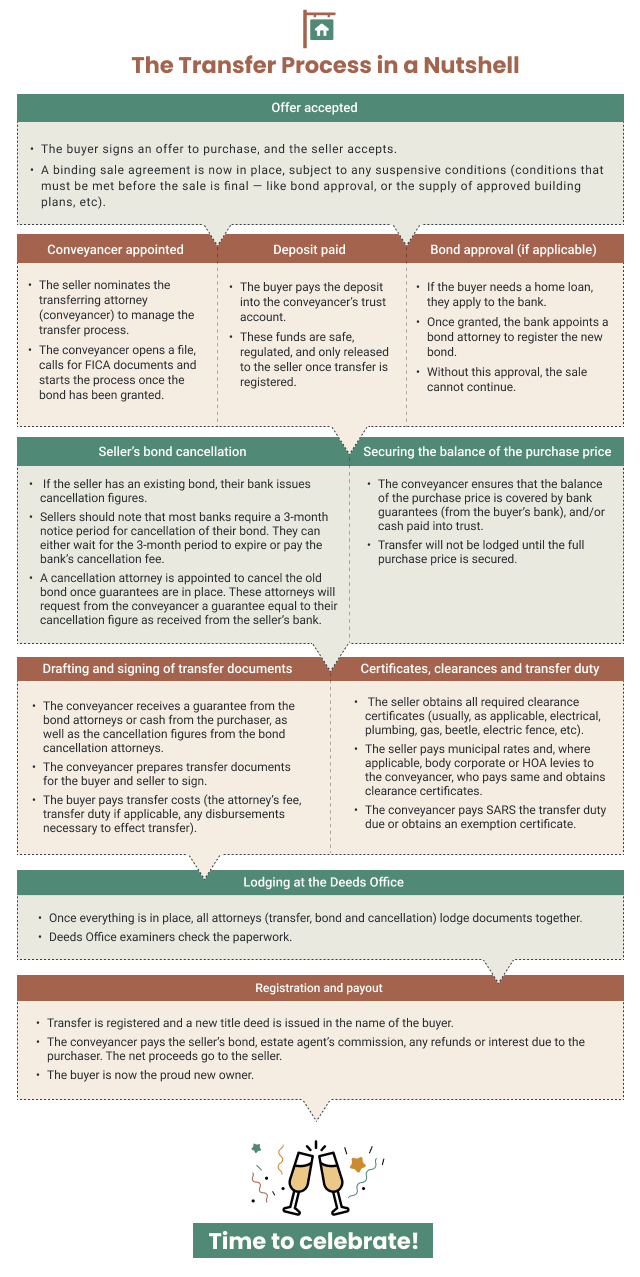
Spring is in the air and, as the annual uptick in property sales kicks in, let’s address two questions commonly asked by both sellers and buyers who are unsure about exactly what happens after they sign their sale agreement:
How does the transfer process work?
How long does it take before the seller gets paid and the buyer becomes the new registered owner?
Let’s begin with this simplified “in a nutshell” flowchart of the transfer process:
How long does it all take?
How long is a piece of string? If everything goes swimmingly and the bureaucratic stars truly align in your favour, the total timeframe from signing the sale agreement to popping the champagne could be as little as eight weeks. On average, however, it’s safer to work on no less than ten to 12 weeks, and possibly a lot more.
What could delay things? This is a complicated process involving a disparate array of role-players and a host of opportunities for unforeseen delay. Some of the more common sources of delay (and frustration!) centre on bond approval, bank processes, SARS and municipal delays, clearance certificates and repairs, lost title deeds, intervening public holidays, and Deeds Office backlogs. But the list really is endless.
Bottom line: you need professionals in your corner to protect your interests and to move the process along as quickly as possible. We’re here to help!
Disclaimer: The information provided herein should not be used or relied on as professional advice. No liability can be accepted for any errors or omissions nor for any loss or damage arising from reliance upon any information herein. Always contact us for specific and detailed advice.
“If you suspect deceit, hit delete!” (Online cybersecurity slogan)
October is Cybersecurity Awareness Month, a good time to note that as cybercrime continues to grow, more and more businesses and individuals are falling victim to the dreaded “BEC” or “Business Email Compromise” fraud.
The million-dollar question: Who takes the hit?
Typically in a BEC fraud, email or other electronic communications between a creditor and debtor (often a seller and buyer, or service provider and client) are hacked by criminals, who con the debtor into paying what they owe into the fraudster’s bank account. By the time the parties realise they’ve been had, the criminals are long gone, and all that remains is the million-dollar (sometimes quite literally!) question: “Which one of us takes the hit?”
Until now we have been faced with conflicting High Court decisions on this point, but now the SCA (Supreme Court of Appeal) has settled it: The risk is the debtor’s.
A car dealership must pay twice over
It was a classic case of BEC: A dealership bought two Hyundai Nissan NP200 vehicles from another dealership for R145,000 each. The seller issued invoices showing its banking details. The buyer paid by EFT and sent proof of payment to the seller, which happily (without checking that the funds had actually landed in its account) delivered the vehicles to the buyer.
As always with these cases, one can imagine the sinking feeling that greeted the parties’ realisation that the seller’s emails and the attached invoices had been intercepted, and the banking details subtly altered. As a result, the buyer had paid the full R290,000 to the criminals’ bank account.
Long story short, a real seesaw of a legal battle ensued. The buyer said, “I’ve already paid you”. The seller retorted, “No you haven’t, you paid the criminals,” and sued the buyer for the R290k. The seller won in the Regional Court, lost on appeal to the High Court, but then turned the tables again and celebrated victory in a further appeal to the SCA.
Verify, verify, verify
The SCA’s findings amount to this:
The onus is always on you as buyer to prove, on a balance of probabilities (i.e. more likely than not), that you have paid the seller.
When you pay by EFT, you must show that the seller actually got the money. In other words, that you paid into the correct bank account.
Creditors (recipients) have no legal duty to protect debtors (payers) from the possibility of their accounts being hacked where the debtor could have taken steps to protect itself but failed to do so.
The obligation therefore is on you as debtor to ensure that the bank account details in the invoice are in fact correct and verified because “it is the debtor’s duty to seek out his creditor”. Fail to follow basic verification steps, and your payment to the wrong account does not remove your liability to pay the debt — you still have to pay your creditor.
Bottom line, the buyer in this case should have verified the banking details given in the emailed invoices before paying. It didn’t, so it couldn’t prove that it had paid into an account authorised by the seller.
It must pay the seller the R290k, with interest and doubtless substantial legal costs.
Don’t make the same mistake
These scams grow more sophisticated by the day, fuelled now by AI-perfected deep fakes, cloned websites and social engineering. Treat all emails, all electronic messages, and all electronic invoices with great suspicion — even if they appear to come from businesses you have known and trusted for decades. Verify bank account details (preferably by speaking to the creditor directly on a number you know to be correct) before paying a cent.
Property sales are particularly vulnerable
Be especially vigilant when buying or selling property because these high-value sales are a particular focus for cybercriminals worldwide. There are rich pickings in the offing, and the opportunities for baddies to intercept and falsify emails is multiplied by the range of trusted role players involved — typically several sets of attorneys, estate agents, and banks as well as the buyers and sellers themselves.
A final note on online security
Let’s end off with a note to everyone: Keep reminding your whole team (not just your accounts department) that securing your computer and email systems against bad-actor compromise is no longer a nice-to-have, it’s essential. This whole unhappy saga could all have been avoided if everyone involved had followed basic security protocols. Prevention is always better than cure.
Give us a call if you need any help.
Disclaimer: The information provided herein should not be used or relied on as professional advice. No liability can be accepted for any errors or omissions nor for any loss or damage arising from reliance upon any information herein. Always contact us for specific and detailed advice.
We use cookies on our website to give you the most relevant experience by remembering your preferences and repeat visits. By clicking “Accept All”, you consent to the use of ALL the cookies. However, you may visit "Cookie Settings" to provide a controlled consent.
This website uses cookies to improve your experience while you navigate through the website. Out of these, the cookies that are categorized as necessary are stored on your browser as they are essential for the working of basic functionalities of the website. We also use third-party cookies that help us analyze and understand how you use this website. These cookies will be stored in your browser only with your consent. You also have the option to opt-out of these cookies. But opting out of some of these cookies may affect your browsing experience.
Necessary cookies are absolutely essential for the website to function properly. This category only includes cookies that ensures basic functionalities and security features of the website. These cookies do not store any personal information.
Any cookies that may not be particularly necessary for the website to function and is used specifically to collect user personal data via analytics, ads, other embedded contents are termed as non-necessary cookies. It is mandatory to procure user consent prior to running these cookies on your website.