“Good rules make good neighbours.” (Old proverb, updated)
The many benefits of living in a residential complex come, naturally enough, with obligations as well as rights.
With its innate potential for conflict between competing rights, community living requires a fine balancing act between the individual rights of owners and residents, and the rights of the community as a whole.
Good rules make good neighbours
Which is of course where a complex’s rules and regulations come into play. Rules provide a structured framework to regulate issues of common concern. Management rules concentrate on administrative and financial issues, while conduct rules (which we’ll focus on in this article) address issues such as noise, pets, parking, use of common property and so on. They are essential not only for protecting everyone’s individual and communal rights, but also to minimise disputes, ensure long-term sustainability and maintain property values.
A well-managed complex benefits everyone – residents, investors, landlords etc.
The sight-impaired owner and his washing machine
Of course, conduct rules are meaningless without enforcement, and that exposes everyone concerned to another balancing act: consistent enforcement versus over-rigid and unconstitutional enforcement.
A recent Supreme Court of Appeal (SCA) decision highlighted this in the case of a complex with a communal washing area.
Before buying his unit in a complex in Gauteng, a visually-impaired man was assured by the estate agent – incorrectly as it turned out – that he would be entitled to modify the washing area directly outside his unit. He duly, without body corporate authority, moved his washing machine into the area and installed piping and a tap, with a security gate and plastic roof sheeting to protect it from the elements. All this, he said, was necessary both to ensure his safety (he cited the danger of slipping in water leaks which he wouldn’t be able to see) and security for his washing machine and clothes.
The body corporate was having none of that and removed the gate and plastic sheeting, citing its conduct rules which prohibit any owner from making alterations to the common washing area. It refused his request for an exemption from the rules on account of his visual impairment, a mediation attempt failed, and eventually his appeal against a CSOS (Community Schemes Ombud Service) ruling found its way to the SCA.
What came out in the wash
The end result? The body corporate is ordered to allow the owner exclusive use of a portion of the common washing area for his washing machine, plus he can install a protective cover over it at his own expense. He must maintain both in good repair, cannot damage the common area wall, has to pay a contribution levy, and must make good all changes when he leaves.
The Court’s reasoning gives us a clear roadmap to our rights, both as bodies corporate and HOAs trying to enforce rules and regulations, and as owners feeling prejudiced by unjustifiably rigid enforcement of them:
The duty to reasonably accommodate persons with disabilities: Our Constitution prohibits unfair discrimination and enshrines a right to dignity and equality as per the Promotion of Equality and Prevention of Unfair Discrimination Act (PEPUDA) which prohibits any failure to take steps to reasonably accommodate persons with disabilities.
When rigid enforcement of rules isn’t justified: The body corporate’s refusal to accommodate the owner in this case didn’t take into account that his modifications were necessary for safety reasons, they were proportionate, tailored for his disability, and confined to what he considered essential to prevent harm to himself. They caused no undue inconvenience or hardship to other members of the scheme, nor any expense for the body corporate. Its rigid attitude in enforcing its conduct rules was not justified, and its failure to give him its conduct rules electronically or in Braille was unjust.
What does “reasonable accommodation” entail? Perhaps the most critical of the Court’s findings is this: “To achieve the objective of equality, I find that reasonable accommodation in a case like this may include allowing structural modifications, granting exclusive rights or exempting disabled residents from burdensome rules.”
The “minimum hardship to members” principle: At the same time, a body corporate must, in establishing what is and isn’t reasonable in the circumstances, “espouse the principle of minimum hardship to its members”. Witness the strict limits imposed by the Court in this case on the unit owner’s rights of usage.
Thin end of the wedge or just a balancing act?
There may be some concern amongst bodies corporate and HOAs that this is the “thin end of the wedge” when it comes to effective enforcement of rules and regulations. When faced with individual requests which go against the rules and regulations, where should bodies corporate and HOAs draw the line?
Ultimately, the safest course is probably to keep on performing that delicate balancing act we mentioned above, plotting a careful course between individual and communal rights fairly, impartially and reasonably. Common sense isn’t as common as it should be.
Whether you’re an owner, body corporate or HOA, we’re here to help you plot that course!
Disclaimer: The information provided herein should not be used or relied on as professional advice. No liability can be accepted for any errors or omissions nor for any loss or damage arising from reliance upon any information herein. Always contact us for specific and detailed advice.
“It is a comfortable feeling to know that you stand on your own ground. Land is about the only thing that can’t fly away.” (English novelist Anthony Trollope)
With interest and home loan rates at their lowest since 2022, it’s no surprise that South Africa’s property market confidence level at the end of 2025 was sitting at a record high of 87%. That will have been boosted by the country’s positive economic outlook following Budget 2026, and by Budget 2026’s 50% increase in the primary residence exclusion (which should stimulate sales by reducing the CGT payable by sellers).
If you are a buyer about to put in an offer on a house, remember to budget for the various costs you’ll face over and above the purchase price. In all the excitement of your purchase (particularly if it’s your first house!) it’s easy to underbudget. But you really don’t want to risk any unpleasant financial surprises. If you do breach a term of the sale agreement by not paying something on time, you could even face cancellation of the sale and a damages claim.
Only with a proper budget and cash flow forecast can you be confident both that you really can afford to offer for the house you’ve fallen in love with, and that you’ll be able to pay everything you need to, when you need to.
Have a look at the list we’ve put together below and use it to prepare your own detailed cash flow forecast. Ignore anything that doesn’t apply to you and bear in mind that every buyer’s situation will be unique, so this is no more than a generalised checklist.
Costs payable before transfer
The deposit: Most sale agreements – often titled as an “Offer to Purchase” (OTP) until it’s accepted by the seller – require you to pay a deposit, usually 5% or 10% of the purchase price.
Bond/home loan initiation fee: This fee normally incorporates a valuation fee and is added to your loan, but check with whichever bank you use.
Homeowner’s insurance policy and life cover policy (if required by the bank): Be sure to provide for payment of the first premiums before bond registration.
Balance of the purchase price: If the deposit you paid and the bond you took out don’t cover the full price, you’ll need to pay the balance before transfer.
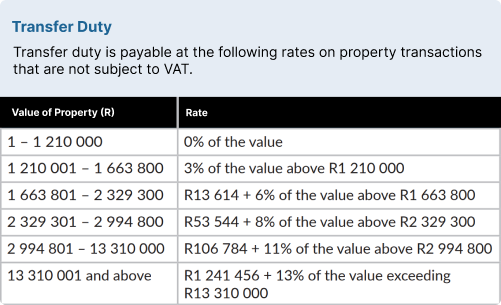
Transfer duty: Unless VAT applies to the sale, transfer duty is payable. This is a government tax payable via SARS before transfer. It applies to all property sales over R1,210,000, on a sliding scale linked to the sale price. This can be a substantial cost!
Transfer fees: The transferring attorney (conveyancer) charges fees based on a sliding scale linked to the sale price. Added to the account will be charges for FICA verification, deeds searches, postages and petties, other disbursements and the like.
Bond registration fees: If you take out a bond, the bank appoints an attorney to register it, with the fees calculated on the size of the loan and including the attorney’s fees, FICA charges and a prescribed Deeds Office registration fee.
Deeds Office fees: These are government charges for both transfer and bond registration.
Rates clearance: Your local municipality will require advance pro-rata payment of municipal rates before it issues the necessary clearance certificate.
Levy clearance: Similarly, if you are buying into a complex, the sectional title’s body corporate or Homeowners’ Association (HOA) will require pro-rata levy payments before issuing a clearance certificate.
Occupational interest (if applicable): If you take occupation before transfer, you need to budget for whatever occupational interest is provided for in the sale agreement.
Utility deposits: If required by your local municipality when opening up water and electricity accounts.
Moving costs: Don’t overlook these when budgeting!
Some of these costs are easily overlooked, but they can add up alarmingly. So, plan for them all before you put in your offer to purchase.
Ongoing monthly costs after transfer
Include bond instalments, municipal rates and taxes, levy payments (if you buy in a sectional title or HOA), utility charges, insurance premiums for the property and the contents, and so on.
One-off costs after transfer
If you plan to do alterations or repairs, redecoration, garden revamps, furniture replacement or anything similar, add these costs to your budgeting so you don’t suddenly run out of money and have to postpone them. For long-term planning, set aside a budget for ongoing home maintenance.
As always, we are here to assist, so let us know if you have any questions, need any further information, or would like help in creating a cash-flow projection specific to your purchase.
Disclaimer: The information provided herein should not be used or relied on as professional advice. No liability can be accepted for any errors or omissions nor for any loss or damage arising from reliance upon any information herein. Always contact us for specific and detailed advice.
“The only man who sticks closer to you in adversity than a friend is a creditor.” (Evan Esar)
Body corporates face a familiar problem. Owners fall into arrears. Levies go unpaid. Legal costs mount. The temptation is to reach for the most forceful remedy available.
Sequestration may seem like that remedy. If an owner will not pay, why not have them declared insolvent?
A recent Gauteng High Court judgment offers a clear warning. A body corporate sought the sequestration of a unit owner for levy arrears exceeding R1.4 million. With such a substantial debt, the body corporate’s frustration was understandable. But the application failed.
The court held that the body corporate had not met the statutory requirements under the Insolvency Act. In particular, it had not shown that sequestration would be to the advantage of creditors. The court also noted that the body corporate had other execution remedies available and emphasised that sequestration proceedings are not intended to function as a debt-collection mechanism.
What is sequestration?
Sequestration is a court-ordered insolvency process under the Insolvency Act. It applies where a debtor can no longer meet their financial obligations. The court places the debtor’s estate under the control of a trustee, who sells the debtor’s assets and distributes the proceeds among creditors.
The test for sequestration
To succeed, the applicant must establish three things:
The debtor has committed an act of insolvency, or is actually insolvent.
There is reason to believe sequestration will be to the advantage of creditors.
The applicant has a liquidated claim against the debtor.
The second requirement is where many applications come unstuck.
Where sequestration applications unravel
Sequestration is not designed to punish debtors or pressure them into payment. It’s a collective remedy, intended to ensure the orderly distribution of a debtor’s assets among all creditors.
The applicant must prove that there’s a good chance that creditors will receive a meaningful dividend. If the debtor has no realisable assets, or if the costs of sequestration would consume whatever value exists, the application will fail. The court will not grant sequestration simply because a debt is owed.
Sequestration is not leverage
In practice, some creditors use sequestration applications as a form of pressure. Their reasoning is simple: the threat of insolvency may prompt the debtor to settle. But our courts have made clear that this is not appropriate.
In this case, the court emphasised that insolvency proceedings are not a private debt-collection mechanism. They carry serious consequences: loss of control over assets, restrictions on legal capacity, and reputational harm. These consequences are justified only where the statutory purpose is served.
Where the true aim is to recover a debt rather than administer an insolvent estate, the court will refuse the application.
What body corporates should consider
Before pursuing sequestration, a body corporate should ask practical questions.
Does the owner have realisable assets? If the only asset is the unit itself, and it is bonded, there may be little left after the bondholder is paid.
Would the costs of sequestration exceed the likely recovery?
Has the body corporate exhausted more conventional remedies? A judgment, followed by execution against property, may be more direct and effective.
If the answers suggest that sequestration will not benefit creditors, the application is unlikely to succeed.
Other options
Body corporates have several remedies for levy recovery: obtaining a judgment and executing against the property, applying for an attachment of emoluments, or seeking a sale in execution.
Each has its own requirements, but they are all designed for debt recovery (unlike sequestration).
Where this leaves body corporates
Sequestration is a remedy of last resort, not a debt-collection tool. The Insolvency Act sets strict requirements, and courts will hold applicants to them. If you are unsure which remedy is appropriate, we can help.
Disclaimer: The information provided herein should not be used or relied on as professional advice. No liability can be accepted for any errors or omissions nor for any loss or damage arising from reliance upon any information herein. Always contact us for specific and detailed advice.
“We are also proposing additional tax measures to ease the financial burden on households and businesses, by adjusting personal income tax brackets and rebates fully in line with inflation.” (Minister of Finance Enoch Godongwana)
How much will I save if I sell my house?
A big highlight for property sellers and buyers is that, having remained unchanged since 2012, the primary residence exclusion for Capital Gains Tax has been increased from R2 million to R3 million. In addition, the annual CGT exclusion has been increased for individuals by 25% from R40,000 to R50,000, and for deceased estates by 47% from R300,000 to R440,000.
The big win is that when you sell your primary residence (the home you live in), the first R3 million capital gain is now excluded from CGT.
Have a look at the illustrative savings calculation below:
Primary residence CGT exclusion: R2m vs R3m
Transfer duty threshold unchanged
Unchanged from last year, you pay no transfer duty if the property you are buying sells for at (or below) the set threshold of R1,210,000.
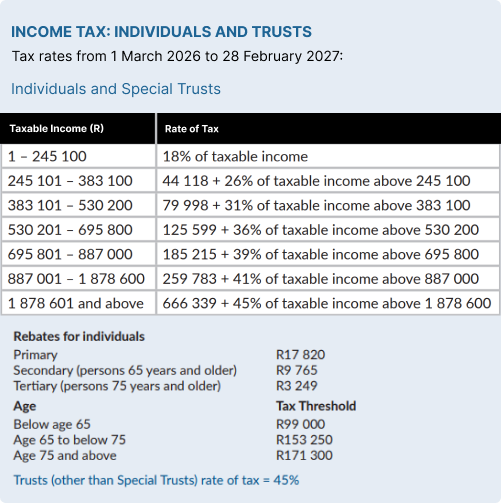
Individual taxpayers:Your tax rates (and the associated rebates and medical tax credits) are increased in line with inflation. That’s welcome relief after last year’s unchanged tax tables which resulted in “fiscal drag” (also referred to as “bracket creep”) for anyone receiving a salary increase that pushed them into a higher tax bracket.
Trusts: Special trusts are by and large taxed as individuals, but other trusts are taxed at a flat rate of 45% – also unchanged from last year.
Disclaimer: The information provided herein should not be used or relied on as professional advice. No liability can be accepted for any errors or omissions nor for any loss or damage arising from reliance upon any information herein. Always contact us for specific and detailed advice.
“Fraud unravels property transactions even where innocent third parties are involved.” (Extract from judgment)
Congratulations, you’re the proud new owner of your dream home! Your name’s on the title deeds, and your ownership is registered in the Deeds Office. That’s conclusive proof that the house is yours, right? Regrettably, this isn’t always the case…
Although registration is usually proof of ownership, there are exceptions. One exception is fraud. And a recent High Court case is a sharp reminder to every party to a property sale and transfer (seller, buyer, estate agent, conveyancer and bonding bank) that any sale and transfer tainted by fraud will almost certainly unravel.
As we shall see, a crooked “conveyancer” was at the heart of this particular saga, so perhaps the most important lesson here is one for sellers. Choose your conveyancer with care!
A crooked “conveyancer” defrauds both seller and buyer
Many of the facts in this convoluted story were in dispute, but the Court’s decision rested on these findings:
The owner, since 2011, of a house in Bloemfontein lived there with her elderly mother. She signed an agreement in 2020 to sell it for R300k to a trust. The sole trustee’s wife was an attorney, but not a qualified conveyancer. Nevertheless, she was appointed in the sale agreement as the “conveyancer” to attend to the transfer.
Shortly after signing the deed of sale, the owner changed her mind and said she was cancelling the sale. Although her “cancellation” seems to have been accepted by the trust, it was invalid for lack of being recorded in writing and signed. What her attempt at cancellation did prove was that she no longer had any intention of passing transfer to the trust. Moreover, the whole sale agreement fell through when the trust failed to get a bond as required by the bond clause. In the end, the owner received not a cent of the R300k, and presumably she spent the next three years happily confident that the sale had fallen away.
Imagine her shock when in 2023 she received an eviction application from a couple who had, without her knowledge, bought the house from the trust for R480k. Only then did she find out that the trustee and his attorney wife had secretly transferred her house, in consecutive transfers on the same day in 2022, firstly from her to the trust, and then from the trust to the couple. The couple were of course now convinced that the house belonged to them.
Off went our original owner to the High Court, which held that there was no doubt that the husband-and-wife team of trustee and attorney had acted in cahoots to defraud both the original owner and the eventual buyers. It accordingly declared both sales and transfers to be invalid and ordered the house to be re-transferred to the original owner.
Fraud unravels all
At the heart of the Court’s decision lies the old Roman concept of fraus omnia vitiat or “fraud unravels all”. There are some exceptions to the application of this principle in our modern law, but the general rule remains that where a property sale is tainted by fraud, any purported sale or transfer of ownership resulting from it is null and void.
Moreover, one can never pass on to another person more rights than one has. Since the sale to the trust was void, all subsequent sales must also be void regardless of registration of transfer. In any case, the second sale agreement had lapsed, again because of non-fulfilment of a bond clause.
For all those and a variety of other reasons, the original owner had never lost her ownership despite the transfers being registered in the Deeds Office.
The couple who bought the house for R480k must now presumably carry on paying their home loan instalments despite having no asset to show for it, and will be wondering whether they can recover their losses from anyone.
Everyone’s at risk, innocent or not
As the Court put it: “Fraud unravels property transactions even where innocent third parties are involved.”
Innocent or not, the seller might have lost her house had she been found to have enabled the fraud.
The buyers, despite being innocent of any fraud, did lose their house. They also have to pay legal costs (the Court criticised their delay in pursuing transfer and in finding out about the occupants) and have no guarantee of getting their money back from anyone.
Even the estate agents and the bank might have found themselves accused of negligence, perhaps for failing to inspect the house and asking the occupants about the basis for their occupancy. Had they done that, they would have uncovered the fraud.
Bottom line is this: Sellers, don’t take chances when choosing your conveyancer!
Disclaimer: The information provided herein should not be used or relied on as professional advice. No liability can be accepted for any errors or omissions nor for any loss or damage arising from reliance upon any information herein. Always contact us for specific and detailed advice.
“All you need is love… and a good lawyer.” (Anonymous)
February, with its Valentine’s Day chocolates, roses and declarations of undying love, should be a month for romance, not legal niceties. But in the real world, love and the law are inextricably linked because any relationship’s structure and consequences are inevitably governed by legal principles. Losing sight of that can expose you to unnecessary angst, dispute, and litigation.
A recent High Court fight between an estranged couple over their jointly-purchased dream house illustrates this neatly.
Broken dreams, and a fall out over the house
A couple’s four-year romantic relationship saw them living together first in her mother’s house and then in his apartment. They then decided to buy a house together with the idea of making their relationship more permanent.
Unfortunately, that dream came to nought – their relationship ended a month after the property purchase, leaving only one of them to live in the house and to pay all the ongoing costs while they decided what to do next.
In due course they fell out over how to end the co-ownership and how to adjust their respective claims for past and future property costs.
Their dispute reached the High Court, which ordered firstly that the co-ownership be terminated. This was necessary, because no co-owner can be forced against their will to remain a co-owner where the relationship between the co-owners has deteriorated to such an extent that it can’t continue.
Then, using an old Roman law remedy still in use today (the “actio communi dividundo”) the Court dealt with both the division of the property, and the adjustment of the various financial claims between the parties. As is usually the case, these were complex and intertwined after years of cohabitation.
Importantly, the Court noted a modern move away from the traditional principle that the property should necessarily be sold by public auction to the highest bidder, towards a much more flexible approach based on the Court having a wide discretion to ensure a fair and practical outcome in each case.
Thus, having considered all the circumstances, wishes and claims of both parties, the Court ordered that the ex-partner living in the house has a first option (valid for 60 days) to buy the other’s half share at valuation. If he doesn’t, he must offer it for sale on the open market at a fair and reasonable market-related price. If there’s still been no sale after 6 months, the Sheriff of the High Court becomes a “receiver and liquidator” and has 4 months to auction the house. The bond, costs and parties’ related financial claims will be settled from the proceeds as directed by the Court.
“Co-ownership is the mother of dispute” – But it needn’t be
“Co-ownership is the mother of dispute” (“communio est mater rixarum”) is another old Roman law concept mentioned by the Court. It confirms that joint ownership has always, since ancient times, inherently provided fertile ground for instability and dispute.
But that needn’t be so. An upfront agreement between joint owners, whether their arrangement is grounded in a commercial or a personal relationship, can hugely reduce the risks of later uncertainty, disagreement and litigation.
Put as much detail into your agreement as you can, including a detailed process of how to end your co-ownership if required. Litigation – with its delay, expense, and uncertain outcomes – should never be embarked on lightly. As the Court wryly quoted from a previous decision, “a court cannot perform miracles”. It will of course do its best to craft the fairest possible outcome for both parties, but avoiding the dispute altogether is always a better option for everyone involved.
P.S. Don’t forget your cohabitation agreement
As a final thought, if you are living with your life partner, you should have a full cohabitation agreement to cover not only your co-ownership arrangement, but also all the other financial and personal aspects of your relationship that would normally be governed by our marriage laws.
Disclaimer: The information provided herein should not be used or relied on as professional advice. No liability can be accepted for any errors or omissions nor for any loss or damage arising from reliance upon any information herein. Always contact us for specific and detailed advice.
We use cookies on our website to give you the most relevant experience by remembering your preferences and repeat visits. By clicking “Accept All”, you consent to the use of ALL the cookies. However, you may visit "Cookie Settings" to provide a controlled consent.
This website uses cookies to improve your experience while you navigate through the website. Out of these, the cookies that are categorized as necessary are stored on your browser as they are essential for the working of basic functionalities of the website. We also use third-party cookies that help us analyze and understand how you use this website. These cookies will be stored in your browser only with your consent. You also have the option to opt-out of these cookies. But opting out of some of these cookies may affect your browsing experience.
Necessary cookies are absolutely essential for the website to function properly. This category only includes cookies that ensures basic functionalities and security features of the website. These cookies do not store any personal information.
Any cookies that may not be particularly necessary for the website to function and is used specifically to collect user personal data via analytics, ads, other embedded contents are termed as non-necessary cookies. It is mandatory to procure user consent prior to running these cookies on your website.