August 2026 | Wills and Estate Planning
“One ring to rule them all.” (JRR Tolkien in The Lord of the Rings)
When it comes to making sure that you get to choose who inherits what from your estate, there really is only “one will to rule them all,” because our law recognises only one type of testamentary will: your “personal will” or “Last Will and Testament”.
But what about all the advice to put in place a whole range of other “wills” as well? Do we really need to have an “offshore will”, a “digital will”, a “business will”, an “ethical will” or a “living will”?
While calling them all “wills” is confusing (and a real problem if it misleads anyone into neglecting their foundational will as recognised by our Wills Act), these other types of “will” are all useful concepts.
We’ll have a look at them all in turn, but let’s start with the one and only…
One will to rule them all
Often referred to as your “personal will” or “Last Will and Testament”, this is quite possibly the most important document you will ever sign. Whether it’s your individual will or a will made jointly with your spouse or partner, it’s the only way to ensure that your last wishes are honoured, that your assets are distributed to your chosen heirs in accordance with your directions, and that the executor of your deceased estate is someone you can trust to act with professionalism, integrity and as much speed as possible.
Because your personal will lies at the heart of your estate planning, having a professional draw it for you is a real no-brainer. Not only must it be clear, consistent, and concise enough to avoid any possibility of doubt or dispute among your heirs, but it must comply with all the formalities required by our Wills Act.
It must be a physical document, in writing (written, typed or printed) and signed by you in the presence of two competent witnesses. While that requirement will presumably fall away as our laws evolve to allow us to draw electronic wills, video wills and the like, for now a physical, ink-signed document remains essential. If you leave only a non-compliant will, your heirs will have to ask a court to have it accepted as valid – a recipe for uncertainty, delay, cost, and dispute at the worst possible time for your loved ones.
Where do the “joint will”, “mutual will” and “mirror will” concepts fit in? Often useful for couples wanting to combine or link their personal wills with reciprocal provisions, choosing between these rests on a complex mix of personal circumstances and legal, estate and tax planning angles. Please do ask us for advice specific to your circumstances.
Do you also need an offshore will?
If you have offshore assets, you may be advised to make one or more foreign wills in addition to your South African one. You need specialist advice here, to ensure not just the validity of both your South African and your foreign will(s), but also their compatibility with each other, and their overall tax and estate planning efficiency.
What about a “digital will”?
A modern concept that’s been gaining traction lately is the “digital will” idea. It’s essential to understand that this is in no way, shape or form a substitute for your personal will. Nor is it in any sense an invitation to make an electronic or online personal will.
Your “digital will” is not the place to leave digital assets to anyone: you must still do that in your personal will. But it is the place to list all those digital assets, plus all your other online profiles, and to tell your executor how to access them. It’s also your chance to tell everyone what you want them to do with your social media accounts.
Four suggestions:
- To avoid confusion with your real (i.e., personal) will, don’t call it a “will”. Call it your digital wishes, or digital folder, or something similar.
- Separate it from your personal will by incorporating it into a separate document. If you don’t yet have a “Notes” folder with all the information and documents your executor and heirs will need when winding up your estate, now’s a good time to start one.
- Make sure your list is comprehensive, or your heirs may never find out about all those crypto assets you’ve painstakingly accumulated for them.
- Don’t ever record passwords, PINs and other security credentials in an unsecured document. Consider using a reputable password manager with an emergency-access facility.
Do you need a business will?
If you have a business, think about what you want to happen to it if you get run over by the proverbial bus tomorrow. Legally you must bequeath your business as an asset (as a sole proprietorship perhaps, or as shares in a company) in your personal will. Your business will is where you say what you want your heirs, and perhaps also business partners and managers, to actually do with it.
Without guidance, your loved ones could have no idea how they should handle things practically. If confusion and dispute set in when you die, they could tear your whole legacy apart.
Again, share your guidance in a “Notes” document supplementary to your personal will, and rather don’t call it a “business will”. What you actually need is a succession plan, so call it that, and structure it carefully.
The “ethical will” concept
More commonly encountered overseas, the “ethical will” has no legal effect and does not relate to your assets but rather to the personal legacy you want to pass on to future generations.
You might leave a “legacy letter” sharing with all your descendants your personal values, beliefs and life lessons, recording your family’s history and heritage, and leaving personal messages for individual family members. It’s a great way of supporting your heirs in living their lives to the fullest while preserving and enjoying the material wealth they inherit from you.
Your “living will” or “advance medical directive”
Your “living will” or “advance medical directive” has nothing to do with leaving assets to heirs, or appointing executors or guardians or the trustees of family trusts.
It’s your expression of your wishes, and your directions to your family and to your medical carers, as to what you do and don’t consent to when you are no longer able to communicate for yourself.
While the concept’s legal status is still unclear, it has a large measure of professional support and will help, guide, and comfort your loved ones when they need it most, so don’t leave this until it’s too late!
Disclaimer: The information provided herein should not be used or relied on as professional advice. No liability can be accepted for any errors or omissions nor for any loss or damage arising from reliance upon any information herein. Always contact us for specific and detailed advice.
© LawDotNews

May 2026 | Property, Tax, Wills and Estate Planning
“I can’t afford to die; I’d lose too much money.” (George Burns, comedian)
At the heart of any estate plan lies your will. Pair it with a file containing all the information and documents that your executor and heirs will need to wind up your estate, and you’ve laid a solid foundation for protecting your loved ones when you’re no longer around to do so.
Hopefully, most of us have already crossed those two essentials off our “to do” list. But there’s a third step which doesn’t always receive the attention it requires: planning for the costs your estate will have to pay, including a number of taxes.
As with all things to do with SARS and tax, there are many detailed requirements and grey areas involved, so what follows is a general guide only. It’s no substitute for specific professional advice.
The big costs you should plan for
- Costs: Central to your estate planning will be understanding just how much each of your heirs will actually receive from your estate after costs, the most significant of which are usually executor’s fees and government taxes.
- Taxes: There are two main taxes to consider: estate duty, and capital gains tax (CGT). In this article, we’ll focus on the CGT aspect for the simple reason that it’s often forgotten about, and even more often misunderstood.
CGT: The ambush tax lurking in the wings
CGT is one of those low-profile taxes that lurks around unobtrusively in the wings, being ignored and forgotten about until it suddenly pops out of the woodwork.
In this case, the “popping out of the woodwork” will happen when you’re no longer around to be ambushed by it. That’s because CGT is triggered by a taxpayer’s death, which is a “deemed disposal” tax event. In other words, your assets are deemed to have been sold at market value on the day you died. And that triggers a tax liability for your estate on the asset’s growth in value since you acquired it – the capital gain.
Before we get into the nitty-gritty of putting figures to that liability, let’s share a smidgen of good news.
The good news: 3 big exclusions, boosted by Budget 2026
Note firstly that no CGT at all is payable on “personal-use assets”, retirement fund benefits and most mainstream life policies.
Secondly, there’s “spousal rollover relief”: liability for CGT on assets left to your spouse is “rolled over” so that it’s payable not by your estate but later on by your spouse (on sale) or by their estate (on death). That, of course, can make a tremendous practical difference in ensuring that your spouse will be okay financially.
Thirdly, the annual exclusion in year of death, the primary residence exclusion and the small business disposal exclusion can all reduce CGT substantially. And as we note below, Budget 2026 has boosted them all. Good news indeed!
- Annual exclusion in year of death: If you sell assets during your lifetime, your CGT liability is reduced by an annual exclusion of R50,000 (up from R40,000). In the year of your death, this exclusion is boosted to R440,000 (previously R300,000).
- The primary residence exclusion: This is a big one for property owners in respect of their “primary residence” (the home you ordinarily live in), with the exclusion increased from R2,000,000 to R3,000,000.
- The small business asset disposal exclusion: If you leave a small business with a market value of up to R15,000,000 (previously R10,000,000), your estate may qualify for a R2,700,000 exclusion (was R1,800,000) on the assets of the business, which are deemed to have been disposed of on your death. Many small businesses will also qualify for wear-and-tear on assets used in the business. Quantifying this requires professional assistance.
How to calculate CGT
Now for the actual CGT calculation, which will give you a rough idea of the final liability so you can plan for it:
- Include all your assets (except those mentioned above as not being subject to CGT) at their current market value.
- Deduct the base cost of each asset; that is what you bought the asset for plus allowable costs such as costs of acquisition and the cost of subsequent capital improvements.
- Calculate the capital gain or loss by subtracting the base cost from the market value.
- Deduct all exclusions from the capital gain to calculate the net gain.
- Multiply the net gain by the 40% inclusion rate to give you the taxable capital gain.
- Finally, apply your marginal tax rate to that taxable capital gain to give you the final CGT liability.
Putting together a comprehensive estate plan, anchored by your will, is essential to ensure that your loved ones are properly catered for after you’re gone. You know who to call if you need any help!
Disclaimer: The information provided herein should not be used or relied on as professional advice. No liability can be accepted for any errors or omissions nor for any loss or damage arising from reliance upon any information herein. Always contact us for specific and detailed advice.
© LawDotNews

March 2026 | Wills and Estate Planning
“Legacy is not leaving something for people. It’s leaving something in people.” (Peter Strople, former Dell Computer Corporation director)
Leave a personal legacy, not just a financial one
We all know how important it is to our loved ones that we leave behind a valid will rooted in a comprehensive estate plan, but our legacy should go a lot further than just distributing assets.
Sharing with your heirs your values, your family history, and the wisdom your years have granted you can be one of the most important gifts you leave, often outlasting tangible bequests by generations. On a practical level, it will also help your heirs value, preserve and enjoy the wealth and the heritage that you leave them.
Start with a family mission statement
This sounds very corporate and complicated, but in fact it’s really simple and entirely personal. A family mission statement is foundational in legacy planning and will help everyone focus on the values and priorities important to them. As Stephen Covey (author of The 7 Habits of Highly Effective People) puts it “A family mission statement is a combined, unified expression from all family members of what your family is all about – what it is you really want to do and be – and the principles you choose to govern your family life.”
Of course, the mission statement must be collaborative, and everyone, even young children, can share in putting it together. You never know who will come up with a bright idea or two!
There’s a useful downloadable worksheet here if you need help getting started – personalise it to your family’s situation, and adapt it as you go along.
Share and discuss your plans
Openly sharing and discussing your estate planning and the provisions of your will with your nearest and dearest isn’t just an opportunity to prepare everyone for the financial implications of your death. It’s also a great way to involve everyone in your planning and to ask for their input.
Discuss the financial structures you have already put in place, or are planning for the future. Talk about your vision for the wealth you will leave behind and why you have made the bequests you have. Sharing all that, and relating it all to your family mission statement, will significantly reduce the risk of unhappiness and disappointment when the time comes for your last wishes to be implemented.
Craft your “legacy letter”
This isn’t your will (although it’s sometimes misleadingly referred to as an “ethical will”).
What’s the difference? Your formal will, which must comply with all legal formalities to be valid, sets out who is to inherit what from you. In contrast, your legacy letter is an informal and personal letter from you to your loved ones, sharing with them whatever you think will be of value to them in their lives. It needn’t be just one letter – many people choose to write individual letters to each member of their family.
There’s a lot to be said for sharing all these things informally with your family while you are still around, but don’t stop at verbal discussions. Writing them down and leaving them in letter form will give your heirs a permanent point of reference.
What should you include in your legacy letter? Really, anything that you think will help your loved ones live richer and more fulfilling lives. Perhaps share some of your family history, stories of your own life and the lessons it has taught you, your values, and your hopes and dreams for each of them. What challenges have you faced and how did you overcome them? What was really important to you at each life stage? What are your most cherished memories? What stories and advice from your parents and grandparents really helped you? What principles have inspired your financial successes?
The Confucian advice to “Study the past if you would define the future” rings as true today as it did two and a half thousand years ago.
A practical five-point plan brings it all together
- Your estate plan underpins everything, so review and update it regularly.
- Take legal and tax advice on forming a family trust. Depending on your circumstances and objectives, it could be the perfect way of guaranteeing that the financial part of your legacy is protected and managed wisely for generations to come.
As to the more personal side of your legacy, the trust’s name itself will preserve your family name no matter how many of your descendants may in due course acquire new surnames.
- Most importantly, leave behind a valid and updated will (“Last Will and Testament”) that clearly reflects your wishes and complies with all legal formalities.
- To accompany your will, put together a “Notes for my executor and loved ones” file with all the information and documents that your executors and heirs will need when the time comes.
- Last but certainly not least, be sure to include your legacy letter. This ensures that you aren’t just leaving your family all your worldly wealth, but also a real legacy – your own personal message for the future, direct from you to them.
Disclaimer: The information provided herein should not be used or relied on as professional advice. No liability can be accepted for any errors or omissions nor for any loss or damage arising from reliance upon any information herein. Always contact us for specific and detailed advice.
© LawDotNews

January 2026 | Wills and Estate Planning
“Let’s choose executors and talk of wills.” (William Shakespeare in Richard II)
You may have read one of the many online articles about an electronic will being validated recently by the High Court.
Don’t be misled into thinking that electronic wills are now valid as a matter of course – they most certainly are not. Unless and until our Wills Act is updated to say otherwise, not leaving a written and signed will complying with all the Act’s formalities exposes your grieving loved ones to the risk of a hard-fought court battle at the worst possible time.
What makes a will valid?
Only a written, signed will complying with all legal formalities will be accepted by the Master of the High Court. If you leave only a non-compliant will, your loved ones will have to ask the High Court to validate it.
What are these formalities?
- You must sign the will on the last page (at the end of the document) in the presence of two witnesses who must also sign as such.
- If there is more than one page to the will, you must sign every page. Although it’s not strictly necessary for your witnesses to also sign all the pages, it’s good practice for them to do so.
- Your witnesses must be “competent”, that is, at least fourteen years old and mentally competent.
- Don’t let any of your heirs or beneficiaries either sign as a witness or write out any part of the will, as that will disqualify them from inheriting.
At this juncture you may be thinking: “But it’s 2026! Aren’t electronic documents and signatures as valid as physical ones?” Nope, unfortunately not when it comes to wills.
ECTA and electronic signatures
The Electronic Communications and Transactions Act (ECTA) says that generally, with only a few exceptions and requirements, electronic signatures and documents are valid and binding. But – and this is critical – it specifically states that they “must not be construed as giving validity to the execution, retention and presentation of a will or codicil [addendum to a will] as defined in the Wills Act.”
In other words, pen and paper are still non-negotiable requirements when it comes to wills.
Which begs the next question. What happens if for some reason your will is found to not comply with these formalities?
What your heirs must prove to overcome non-compliance
Fortunately, the Wills Act does allow our courts to look beyond technical non-compliance so as to give effect to the deceased’s true intentions.
In such cases the heirs will need to prove:
- That the document was drafted or executed by the deceased.
- The maker of the document must, naturally, be dead.
- The person making it must have intended that document to be his or her will.
That’s the law underlying the Court’s decision in this dispute, so let’s see how it all played out in practice.
A bitter fight over two conflicting wills, one written and one electronically signed
The deceased, at the time a Constitutional Court Justice, made a will in 2014. She then made another in 2021.
In both wills, she had named her children, a granddaughter, and her life partner as her heirs and beneficiaries. Critically, in the 2014 will she had left 100% of her Magersfontein property to her life partner. But in the 2021 will she changed that, leaving the property to her children in equal shares.
Perhaps unsurprisingly, the life partner challenged the validity of the 2021 will, and her children and granddaughter in return asked the High Court to instruct the Master of the High Court to accept it as valid.
It became clear that the 2021 will was formally defective in two respects:
- All three signatures (those of the deceased and her two witnesses) had been appended electronically
- The deceased’s signature was in the wrong place on the document.
Critically, however, the life partner did not dispute the evidence of the two witnesses to the will that the deceased had, after a phone call, emailed them to ask that they append their signatures to the will electronically. He also accepted that the will reflected the deceased’s true intentions and that she had intended it to be her final will.
Finding on this evidence that the deceased had given direct instructions for the drafting of the 2021 will, and that she had indeed accepted that will as her own, the Court instructed the Master of the High Court to accept it as her will.
There’s a very clear lesson for us all here…
Pen and paper rule!
Electronic wills, and electronic signatures on wills, are not automatically valid. The only way to protect your loved ones from all the delay, confusion and cost of a High Court application to get an electronic will condoned is to leave a written, signed will that complies with all the Wills Act’s formalities.
We’re here to help!
Disclaimer: The information provided herein should not be used or relied on as professional advice. No liability can be accepted for any errors or omissions nor for any loss or damage arising from reliance upon any information herein. Always contact us for specific and detailed advice.
© LawDotNews

August 2025 | Wills and Estate Planning
“All that lives must die, passing through nature to eternity.” (William Shakespeare, in Hamlet)
Master’s Office records suggest that less than a third of us leave behind a will when we die. That’s astonishing, given the fact that death is one of the few absolute certainties in our lives.
Why do so many of us put our families at risk like this?
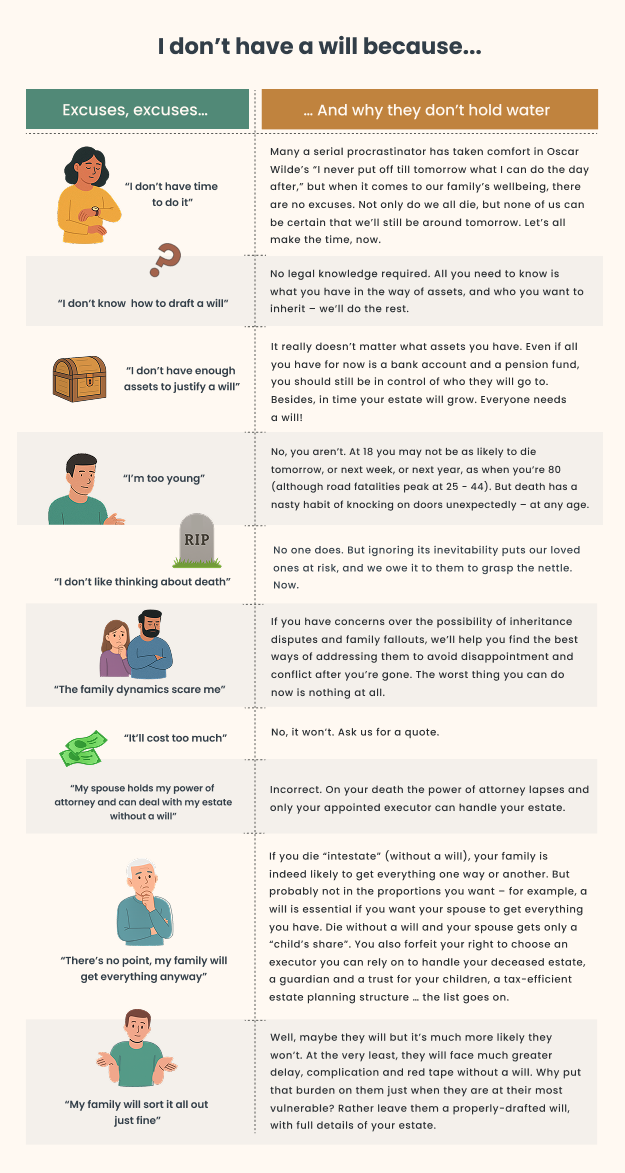
“I don’t have a will because…”
It’s easy to find excuses for doing nothing about a will, with surveys conducted both locally and overseas suggesting that people’s failure to act is normally rooted in one or more of these common excuses:
We’ll help you structure a will and estate plan that honour your last wishes and provide proper protection for your loved ones.
Disclaimer: The information provided herein should not be used or relied on as professional advice. No liability can be accepted for any errors or omissions nor for any loss or damage arising from reliance upon any information herein. Always contact us for specific and detailed advice.
© LawDotNews

May 2025 | Family Law, Property, Wills and Estate Planning
“An ounce of prevention is worth a pound of bandages and adhesive tape.” (Groucho Marx)
It’s a perennial topic of dispute in our courts. A couple lives together, sharing the same roof and everything else in perfect happiness and harmony.
Until it all goes south. Then the gloves come off and, particularly if our erstwhile couple end up dragging each other through the courts, everyone takes a beating. Bloodied, battered and bandaged, they’re going to wish they’d implemented Groucho’s “ounce of prevention” in the first place.
We’ll explain how to keep things amicable. But before we do, let’s consider the case of the life partner who failed to persuade a court to give him a cut of his ex-partner’s house.
Trying to prove a “universal partnership”
Bearing in mind that our law recognises no such concept as “common law marriage” (a pervasive and dangerous myth that just won’t go away), many an ex-life partner has fallen back on trying to prove that the couple had formed a “universal partnership”. Depending on the type and form of the partnership they claim existed, that would give them a cut of the assets of their relationship. But it isn’t easy to prove.
The facts in a recent Limpopo High Court fight illustrate this point. A couple in a romantic relationship had lived in the woman’s house with her daughter. Each of them contributed equally towards household expenses. They decided to extend the house, and the man contributed R416k out of his pension payout for this purpose.
When their relationship broke down after five years, the man tried to convince the Court that a universal partnership had been formed between them, and he asked for a liquidator to be appointed to divide the partnership’s assets equally between the partners.
The Court’s thorough analysis of the law relating to universal partnerships (there are actually two types, both with fancy Latin names) will be of major interest to lawyers. But what really matters most to you on a practical level is that:
- The onus is on you to prove that a partnership existed, and its terms.
- You must prove that you agreed to pool your assets in order to make a profit.
- A universal partnership needn’t be agreed to in writing – it can be formed verbally, by consent, or by the conduct of the parties. That requires inferences to be drawn so it’s a recipe for misunderstanding and dispute. Without a written agreement it’s never easy to prove and our case law is littered with failed attempts.
- Perhaps the most pertinent factor of all is this comment by the Court (emphasis added): “The mere fact that parties cohabitate does not entitle them to a proportionate share of the other party’s estate.”
In the end, the applicant failed to prove that the relationship had been anything more than cohabitation, so he leaves with nothing (other than, of course, a large legal bill).
An ounce of prevention…
All that litigation and unhappiness could have been prevented had the parties, when they first decided to live together, entered into a cohabitation agreement.
Don’t make the same mistake, and be sure to draw up a document covering, at the very least, the following aspects of your relationship as they apply to you:
- When your relationship began or when the agreement takes effect.
- List who owns what both before and during cohabitation (furniture, vehicles, investments and so on).
- Who is responsible for which debts.
- Who owns (or rents) your house, who will pay the bond instalments if any, who will pay for what upkeep, who will pay for any major extensions or repairs, and so on.
- Who will pay what in ongoing contributions to shared living expenses.
- Will you use joint bank accounts and, if so, how will you manage them?
- Will you run your own businesses, a joint business, or no business at all? What will you each contribute, what will you each take out, how will you manage the business/es?
- Who will be responsible for the children’s financial support, schooling etc?
- If your relationship ends:
- How will you terminate it?
- Who will get which assets?
- Who will be responsible for which debts?
- How will you terminate any business relationship you have?
- Will either of you be entitled to ongoing spousal maintenance?
- What happens to your children, to their financial support, and to your parental duties and rights of contact?
- Think of adding a dispute resolution clause to kick in if you can’t agree on anything.
- Anything else? Your circumstances are going to be unique to the two of you, so brainstorm for anything else (who gets the pets, for example) that you’d like to record or agree on at this stage.
Herein lies the rub
Setting out an agreement doesn’t mean you’re planning for failure! In fact, you’re increasing your chances of success. Break-ups are a fact of life, and even if you do grow old and wrinkly together, your cohabitation agreement will still come into its own when one of you dies.
On that note, don’t forget to make or update your will (“Last Will and Testament”) at the same time. Both documents are essential, and the two must be compatible with each other, so make a big note to review/update both together.
Bottom line: you and your life partner should have a cohabitation agreement as well as wills. We’ll help you put all that together.
Disclaimer: The information provided herein should not be used or relied on as professional advice. No liability can be accepted for any errors or omissions nor for any loss or damage arising from reliance upon any information herein. Always contact us for specific and detailed advice.
© LawDotNews